
“Service teaches children and teenagers to look beyond themselves and understand the role they can play in their community and country,” journalist and author Alina Tugend wrote for The New York Times.
The Policy Circle, a national, non-partisan 501(c)3 that supports women in becoming more engaged citizens, defines civic engagement as “all the ways individuals participate in the life of their communities and country. It includes voting, volunteering, public dialogue, advocacy, organizing around shared values and concerns, and staying informed about public issues.”
This definition challenges the common misconception that civic engagement is limited to politics, framing it instead as broader participation in community life.
Students interested in neuroscience can educate the public on brain health by volunteering during Brain Awareness Week and creating mental health and sleep-awareness campaigns for their peers.
Students drawn to economics might research barriers to economic opportunity within their communities or host financial literacy workshops to help individuals make informed financial decisions.
Students interested in public policy may seek to better understand and improve the contexts and conditions that shape youth civic engagement by organizing voter registration drives, participating in city-sponsored community events, or exploring how K-12 education prepares students to participate in democracy.
Students who are also artists may volunteer to paint murals throughout Chicago to celebrate diversity and culture while bringing color to otherwise overlooked spaces.
Every day, Northside students arrive at school from different neighborhoods and realities. When we leave school, we carry lessons and experiences back into the outside world. Civic engagement, I’ve found, exists in that exchange: what we bring into our communities, and what we can gain from them.
Two experiences, in particular, have shaped how I understand and approach civic engagement.
Every Memorial Day and Labor Day, I participate in the Wellington-Oakdale Old Glory Marching Society (WOOGMS) parade, a 63-year-old tradition in Chicago’s Lakeview community.
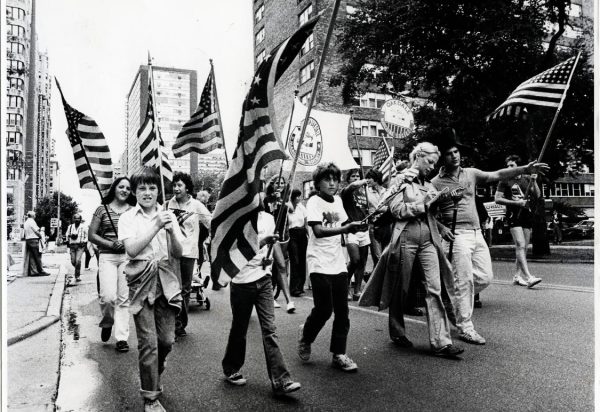
Over the years, my role in the parade has grown alongside me. What began as waving a small American flag from a stroller evolved into distributing flags at age ten, leading the parade at sixteen, and now coordinating the event with other volunteers.
In contributing my time and energy to WOOGMS, I help sustain a tradition centered around community participation and collective bonding.
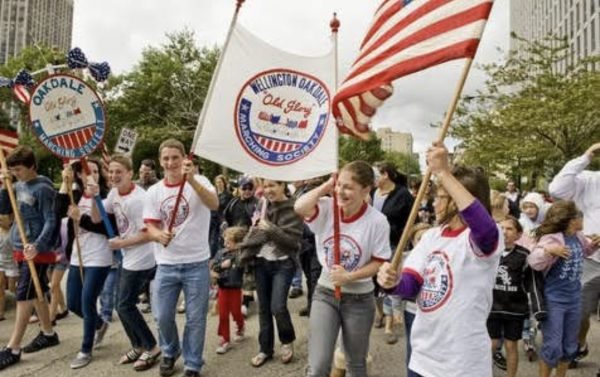
At first, I did not view my involvement in WOOGMS as civic engagement. That changed as I began making connections between my high school classes and the world beyond Northside. Through conversations with residents, volunteers, and local elected officials from different generations and backgrounds, I made natural connections to my AP Government and Politics class.
My internship with Nourishing Hope exposed me to another dimension of civic life: listening to, understanding, and sharing the individual stories behind broader social issues.
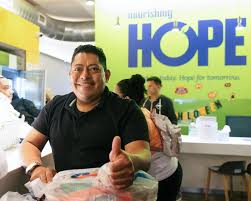
Nourishing Hope is a Chicago non-profit providing food, social services, and mental wellness support. Through conducting interviews, capturing photos, and writing blog posts, I documented how members of the community confront inequality and navigate everyday challenges.
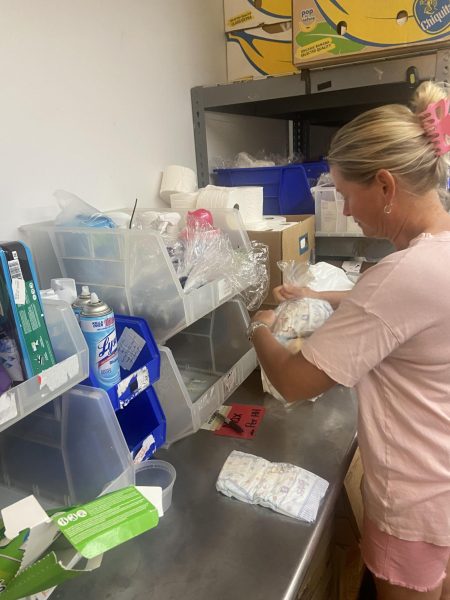
The experience reinforced the idea highlighted in Alina Tugend’s article in The New York Times on youth service: community engagement encourages young people to “look beyond themselves.” With my passion for storytelling, I can foster understanding, mobilize action, and increase empathy to aspects of society too often overlooked.
Civic engagement supports the interconnectedness of our communities. It allows for people’s paths to intersect and ideas to merge.
I now see myself as a member of a larger social fabric, where people with different skills, knowledge, values, and motivations unite to improve the quality of their communities.
For high school students especially, we gain this understanding when we step beyond the walls of our classrooms and recognize that the world is so much bigger.