

The upcoming general primary election in Illinois is on March 17. For many Northside students, this is the first time they are eligible to vote.
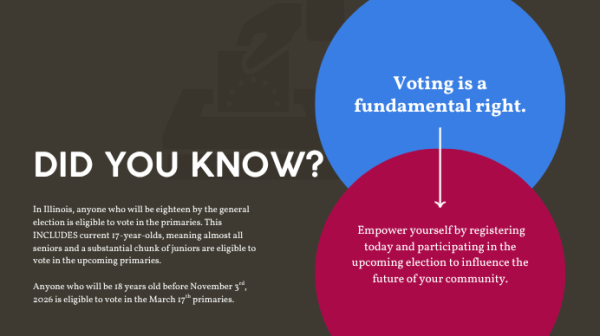
What are the Primaries?
The primaries are the ‘first round’ of elections. The primaries occur within a specific party, and voters vote only within one party. A Democratic voter, for example, will vote for their preferred Democratic candidate on a ballot of only Democratic candidates. The winner of the Democratic and Republican primaries (and some 3rd party candidates) then face off in the general election.
Voting Requirements
- Must be a U.S citizen.
- 18 years old or will be 18 years old by the upcoming general election or consolidated election.
- A resident to their precinct for at least 30 days prior to Election Day.
How to Register to Vote
Here is a slideshow from the Chicago High School Democrats detailing the registration process.
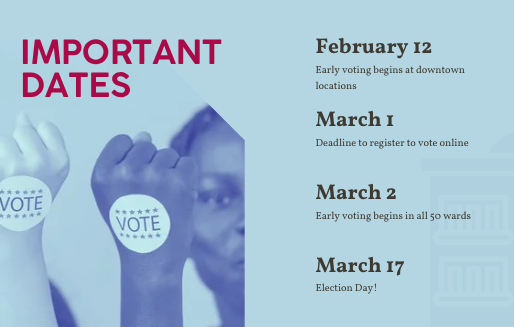
The period to register online or in person has passed. If you are not already registered, you can register in person on Election Day or at an in-person early voting location. If you have changed addresses within the last thirty days and still wish to vote, click here.
To see if you are already registered to vote click here. Many students are automatically registered when receiving their state drivers licenses or through the College Board.
Absentee Ballots
An absentee ballot is a ballot that is completed and mailed in advance of an election by a voter who is unable to be present at the polls during the early voting time period or Election Day.
To submit an absentee ballot you must:
- Complete an application Absentee Ballot Tool.
- Return completed application to your Local Election Office as soon as possible.
- All offices will accept mailed or hand-delivered forms.
- Be sure to double check deadlines to ensure ballots will be counted.
If done in person, the ballot is received one day before Election Day. If done by mail, the ballot is received twelve days before Election Day. If done online, the ballot is received five days before Election Day.
Early Voting
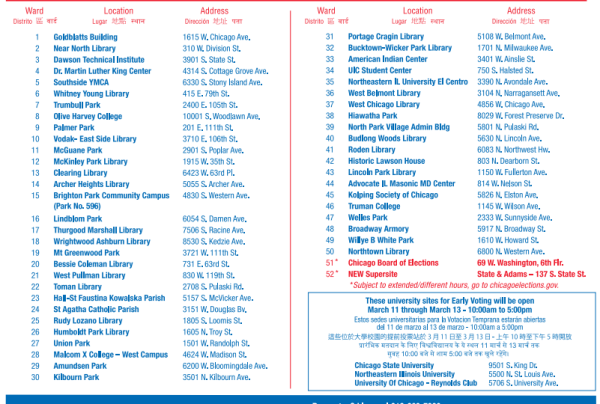
Early voting sites will be open March 11 to March 13 from 10AM to 5PM. Click here to find where your early voting location is. Note: early voting locations are often different from your election day voting location.
Voting By Mail
Voting by mail must be done no more than ninety days before the election and no less than five days before the election.
- Click here for a vote by mail request for Chicago residents. After you fill out the application, mail to the correct address, which is located at the top of the request.
- If your application was approved, a ballot will be mailed to your address.
- Fill out the ballot and return as soon as possible to your local election authority via mail or the dropbox at your local election authority. You can also drop off your ballot in person on Election Day at your local polling place.
Election Day
Election Day for the general primaries is March 17th. It is important to go to the correct polling place for your district. Click here to find your polling place.
On Election Day it is important to bring the correct items in order to vote. If you are already registered to vote at your current address and have voted previously while living there, Illinois voters are not required to have their ID present.
For first time voters or if there has been a change in address in the past thirty days, two forms of ID are required.
One form of ID must include a current address where you are registered to vote, for example, a lease, mortgage, or a utility bill from the last thirty days.
Second ID can be a passport, social security card, driver’s license, bank statement, public aid ID card, Firearms Owners Identification card, or a paycheck from the last thirty days.
Bringing written or printed materials into the voting booth to assist with your voting choices is also allowed and encouraged.
Bringing or wearing any campaign merchandise, pamphlets, buttons, or stickers (electioneering) is illegal via the Illinois Election Code.
How to Research Candidates
Researching information about candidates can be difficult, especially with the large volume of information about candidates online.
- Determine what candidates will be on your specific ballot.
- Research individual candidates using verified, nonpartisan websites. Here are some websites you can look at, but there are many others available online.
- Ballotpedia: centralizes all information on candidates stances, websites, legislation, etc.
- “I Side With. . .” Voting Guide: provides a quiz to help voters find what candidates best match their values.
- Vote Smart: provides biographical information, voting records, positions on issues, interest-group ratings, public statements, and funding for individual candidates.
- PolitiFact Truth-o-Meter: provides fact-checking of statements made by politicians to determine accuracy.
- Open Secrets: Campaign Finance Data: researches and tracks money in government and provides information on groups/individuals that fund specific candidates.
- Read through the candidate’s websites and social media pages.
- Read articles about candidates on verified local news platforms, for example the Chicago Sun Times, Block Club Chicago, Chicago Tribune, NBC, WGN, ABC, and more all provide information and direct quotes from candidates.
- After researching, take notes on specific details. Some questions to consider: Where do they stand on issues you care about? What experience do they have? If they have held office before, did you agree with their decisions? Why or why not? Asking these questions can help you figure out which candidates best align with your values and can help make a decision on which candidates to vote for.
- It is extremely important to carefully evaluate all information found. There is a large amount of misinformation, rumors, and lies online, especially on social media. Be sure to use multiple websites, fact check information, and research what groups or individuals are funding websites, advertisements, and more. Check sources for news articles and look out for signs of paid promotions.
Candidates
Each candidate that will appear on the ballot in a primary is listed below, with their website hyperlinked if they have one.
Federal Senate

Note: Illinois Senator Dick Durbin is retiring, and there are ten Democrats and seven Republicans running to replace him. Senator Duckworth is not up for reelection in 2026.
Democratic: Steve Botsford Jr., Sean Brown, Awisi Bustos, Jonathan Dean, Robin Kelly, Raja Krishnamoorthi, Bryan Maxwell, Kevin Ryan, Juliana Stratton, Christopher Swann
Republican: R. Cary Capparelli, Casey Chlebek, Jeannie Evans, Pamela Denise Long, Jimmy Lee Tillman II, Don Tracy, Max Rice
Independant: Austin Mink, Tyrone Muhammad, Anthony Smith
Federal House of Representatives
This election, there are four open seats (incumbent not seeking reelection) in districts that contain the city of Chicago.
Click here to find your congressional district.
District IL-1
Democratic: Jonathan Jackson (incumbent)
Republican: Marcus Lewis, Christian Maxwell
District IL-2
Democratic : Yumeka Brown, Eric France, Jesse Jackson Jr, Patrick Keating, Donna Miller, Sidney Moore Robert Peters, Willie Preston, Adal Regis
Republican: Mike Noack
District IL-3
Democratic: Delia Ramirez (incumbent)
Republican:Angel Oakly
District IL-4
Democratic: Patty Garcia
Republican: Lupe Castillo
District IL-5
Democratic: Mike Quigley (incumbent), Matt Conory, Ellen Corley, Anthony Michael Tamez
Republican: Tommy Hanson, Kimball Ladien, Barry Wicker
District IL-7
Democratic: Richard Boykin, Kina Collins, Melissa Conyears-Ervin, Anthony Driver Jr. , David Ehrlich, Thomas Fisher, La Shawn Ford, Jason Friedman, Rory Hoskins, Anavel Mendoza, Jazmin Robinson, Reed Showalter, Felix Tello
Republican: Patricia Easley, Chad Koppie
District IL-9
Democratic: Daniel Biss, Bushra Amiwala, Phil Andrew, Patricia Brown, Jeff Cohen Laura Fine, Justin Ford, Mark Fredrickson, Hoan Huynh, Kat Abughazaleh, Bethany Johnson, Sam Polan, Nick Payati, Howard Rosenblum, Mike Simmons
Republican: Rocio Cleveland, John Elleson, Paul Friedman, Mark Su
State Governor
Democratic: JB Pritzker (incumbent)
Republican: Darren Bailey, Ted Dabrowski, Rick Heidner, James Mendrick
State Attorney General
Democratic: Kwame Raoul (incumbent)
Republican: Bob Fioretti, Andy Williams Jr.
State Secretary Of State
Democratic: Alexi Giannoulias (incumbent)
Republican: Walter Adamczyk, Diane Harris
State Treasurer
Democratic: Mike Frerichs (incumbent)
Republican: Max Rice, Max Solomon
State Comptroller
Democratic: Margaret Croke, Stephanie Kifowit, Holly Kim, Karina Villa
Republican: Bryan Drew
State Senate
Click here to find who is in your district. Not all state senator seats are up for election.
State House of Representatives
Click here to find out who is running to represent your district. All House of Representative seats are up for election this year.
County Assessor
Democratic: Pat Hynes, Fritz Kaegi (incumbent)
Libertarian: Nico Tsatsoulis
County Cook County Board President
Democratic: Toni Preckwinkle (incumbent), Brendan Reilly
Republican: Max Rice, Eric Wallace
Libertarian: Michael Murphy, Justin Tucker
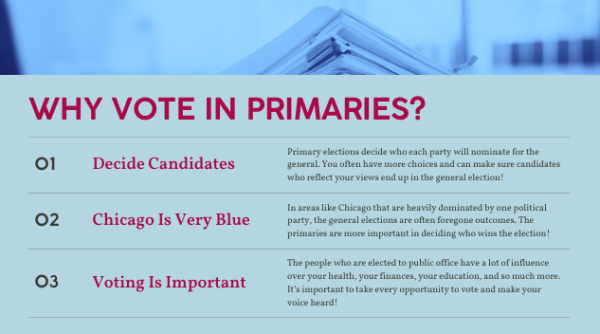
“It’s definitely important for high school students to vote on general principles, because the faith that our votes matter and the belief in elections gets replicated across the whole population. And so if we all think it matters, it definitely does matter,” said Mr. Michael Myers, Northside’s AP US Government and Politics teacher.
Senior and Illinois High School Democrats Chair Veronica Motawi says, “civic participation is important because our elected leaders make decisions and pass laws that very directly impact our day to day lives. If there are issues we care about, we want to make sure that we elect reps who also care about those issues…the only way to get those people elected is to be a participatory citizen.”
If you need assistance or have any questions about registering to vote, reach out to Veronica Motawi ([email protected]) or Amara Patras ([email protected]).