
Chicago Public Schools (CPS) states that their mission as a district is to “provide a high-quality public education for every child, in every neighborhood, that prepares each for success in college, career, and civic life.” How does a rise in Artificial Intelligence (AI) usage play a role in this mission?
For the last couple of years, there has been a noticeable surge of using AI in the classroom, mainly by students. 85% of teachers and 86% of students used AI in the 2024-25 school year, according to “Schools’ Embrace of AI Connected to Increased Risks,” a report released today by the nonprofit Center for Democracy and Technology.
CPS and other school districts around the country have begun to respond to increased levels of AI usage through new policies, restrictions, and guidebooks. In particular, CPS released an official guidebook that covers the subject. This guidebook has been updated at least five times as artificial intelligence continues to evolve.
CPS’s AI Guidebook
Chicago Public School’s first edition of the AI Guidebook was released in the summer of 2024, just as generative AI was beginning to gain traction. The guidebook was created as a model for the 2024-2025 school year, the year serving as a learning period to apply and explore new guidelines. Therefore, the 2025-2026 school year is the first year with this guidebook being fully implemented into the functions of CPS classrooms.
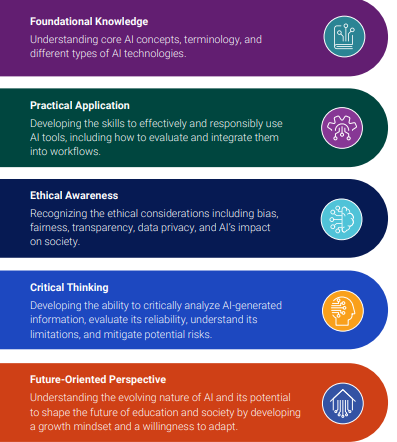
This guidebook emphasizes the importance of transparency while using generative AI. More specifically, the guidebook states that the use of AI must come with a clear, specific identification and citation of artificial intelligence use.
In the classroom, the use of generative AI also must come with approval by teachers. The guidebook also ensures that academics will remain human, in that AI will be used to support learning, not replace educators, stating that “We will leverage AI to personalize learning experiences, empower students to take ownership of their education, and foster critical thinking and problem-solving skills, while ensuring that AI augments, rather than replaces, the essential role of educators.”
The guidebook also has an extensive section directed toward a student audience. It lists ideas of how to use AI to guide learning without overtaking critical thinking skills. For example, ideas listed include using AI as a brainstorming or research tool, to create study guides, to give feedback, to summarize and simplify, or create visual ideas for life.
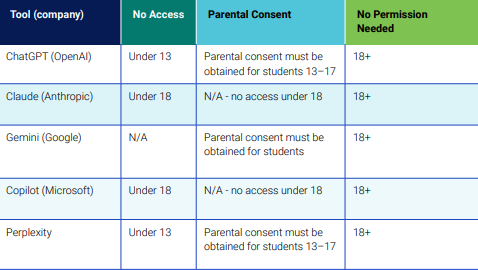
ChatGPT Block for CPS Students
After students returned from winter break in the 2025-2026 school year, ChatGPT was blocked on school chromebooks. This has been met with many questions, concerns, and emotions as students have integrated ChatGPT into their means of learning.
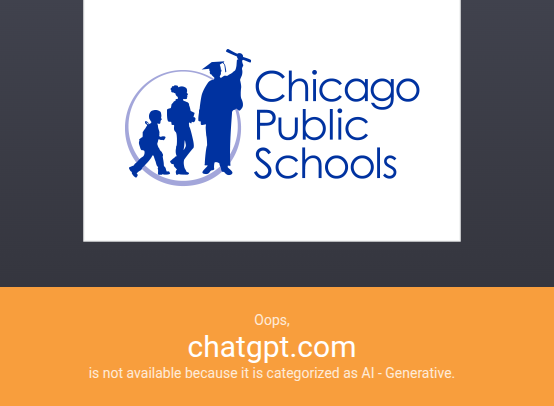
While CPS has provided ways to structure learning with the help of AI in their guidebook, there is still room to explore how students can maintain the development of their critical thinking skills. Our education systems are constantly evolving with rapid technological development, and this ChatGPT ban is a first step that CPS is taking to adapt to a surge of AI usage.
CPS has not released any information or public statement about this ban yet, although there are CPS provided resources available outlining what websites/programs are and are not allowed on their devices. Currently, ChatGPT is listed as “Not Currently Available.”